The Long Read
Why We Never Used Paid Advertising—Until Now
If you follow me on Instagram, you may have spotted a little update in my stories last weekend… For the first time ever, we have embarked on some paid adverts. There was great excitement among the team and me as we spotted our ads appear on Instagram.
Five years into running The Fabled Thread, the decision to finally embark on paid advertising is one I have been umming and ahhing over for months, if not years, but have never taken the leap. In fact, when I first launched The Fabled Thread in February 2020, I did run a few small adverts just to find some initial followers on Instagram. We're talking about an overall budget of probably £500. But once I hit 1,000 followers, I stopped and haven’t paid for advertising since.
That means we’ve done no paid advertising or marketing in any capacity—no gifted kits, no trade shows, no paid editorials, no agencies. Until this summer, there was also no marketing support beyond me! But this year, we’ve been changing tack—after four years of reinvesting everything into product, we have finally started investing in marketing too.
That means I now have marketing support in the form of Jen, we have booked our first trade show (Chelsea Flower Show in May!), we worked with an agency on our SEO in the summer, and… as of last week, we now have two amazing women working with us to run adverts.
Since I know this is the kind of thing I would love to understand if I suddenly started seeing a brand I like advertising, I thought I’d explain:
- Why I’ve been so against paid advertising in the past
- Why we’ve decided to invest in marketing now
- What we hope to achieve through it
Growing Organically: The Power of Word-of-Mouth
Before I dig into why we have decided to start investing in marketing now, I want to explain how we got to this point without investing anything in marketing the business.
Firstly, while they say you make your own luck, there is a huge element of luck in the very early days of a business. As I have written and spoken about before (here is a video!), I come from a finance and chemistry background—nothing to do with the arts, nothing to do with interiors, nothing to do with eCommerce. When I started the business in June 2020, I naively had not even considered how I intended to reach an audience—I had purely focused on developing my kits.
What made that naïve decision not completely catastrophic was timing. I launched the business in the early days of lockdown—the world was trapped indoors as the Covid pandemic swept across the globe, and unlike a normal June, when people are thinking about summer holidays, summer wardrobes, and outdoor activities, everyone was focused on finding things to do inside to distract themselves or keep busy. Embroidery surged, and even though I had only just launched to an audience with a grand total of about 500 Instagram followers, quite remarkably and incredibly fortunately, one of those who found me was a journalist for the Financial Times. Within a month of launching, with not one contact or clue about how to market, we got a feature in How To Spend It magazine, and from there, we grew.
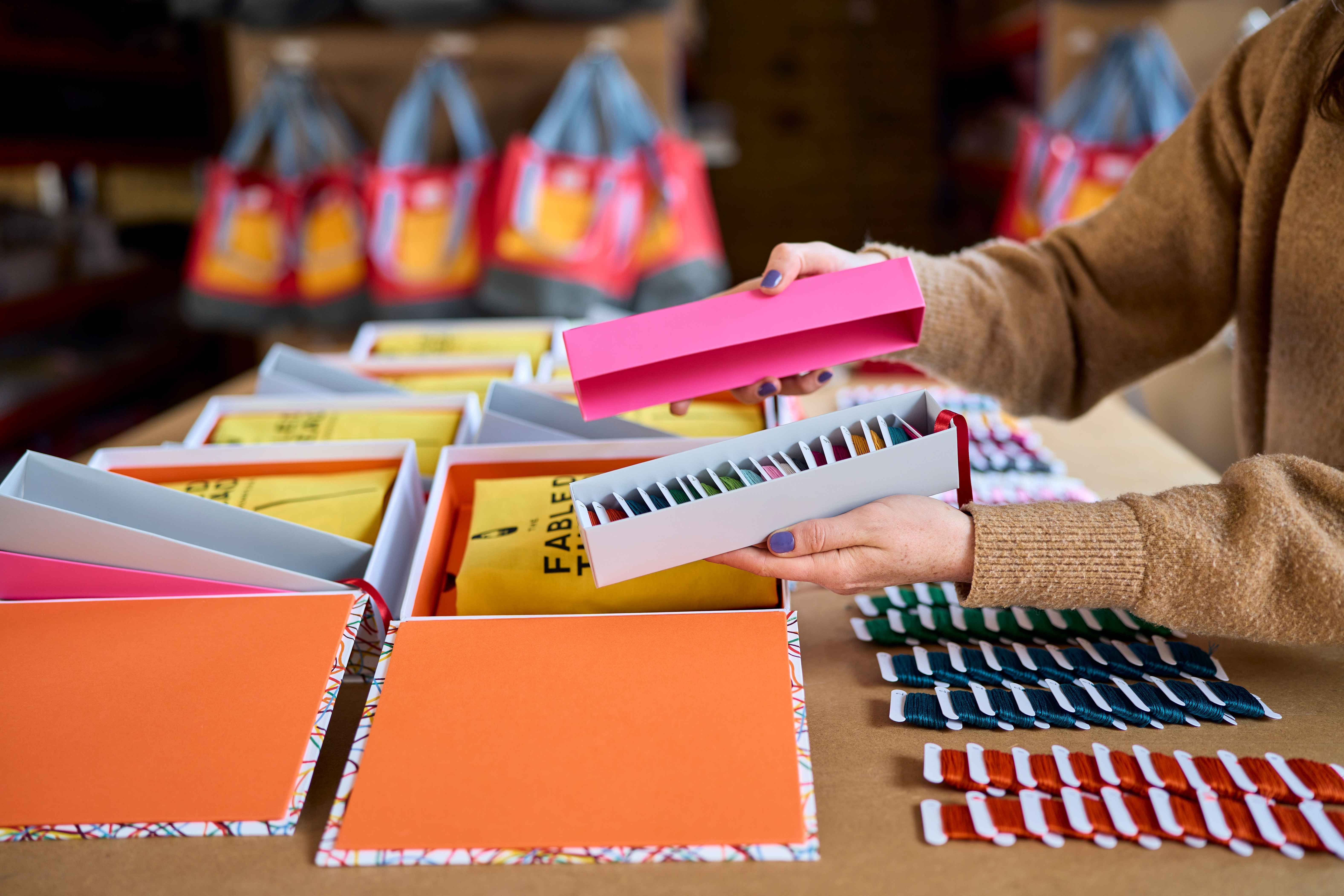
Throughout those early years, my focus has always been on creating a product that genuinely excites people when it arrives—it’s why our packaging is so special—something that people would want to tell their friends about. I have always focused on being authentic, sharing not just the business on our social media but everything else around the business too—be it decorating my house, the ins and outs of how we make the kits, random other crafts, or business decisions like this. Through sharing very openly and engaging with those people who follow our accounts, we have built a proper community.
They say giver’s gain, and we certainly have. Through both the experience people have with our kits and the way we have been able to engage with everyone beyond sewing, we have slowly but steadily built a loyal customer base. This drives everything—it drives journalists getting in touch with us, it drives fairs or venues inviting us to exhibit, it pushes up our Google ranking. The openness I have shown and the dedication to creating a really exceptional customer experience of our products have, in turn, passed on the generosity of our audience. Our customers have enabled the features in everything from Vogue to Elle Decoration to World of Interiors. Our customers have taken word overseas, meaning we have shipped all over the world, with now over 50% of our orders going outside the UK. Our customers are what have caused major brands like William Morris, Schumacher, and Emma Bridgewater to take notice and collaborate with us.
The Hesitation: Why We Avoided Paid Ads for So Long
This reliance I have on our customers and audience to be my marketing channel is the core reason I have held off on ever paying for advertising. The organic growth of the business is thanks to our authenticity, and I have both a fear of how our existing customers would perceive us if they saw us advertising and a concern about how new people who find us through ads would really understand who we are and what The Fabled Thread is all about. In order to reach us and navigate our increasingly complicated and random product range, you have committed time to get to know me. I really appreciate that relationship we have with our audience, the dedication and support they have given us, and I have worried about it being diluted or—without being overdramatic—sullied with what feels to me like a slightly sleazy approach to business.
Second to that, I fundamentally believe a great product should sell itself. If the product is great, if the experience is great, if it makes a meaningful difference to people's lives, then that will grow your business. And that is 100% true—we have an absolutely incredible track record of returning customers, and we know that if a customer comes back once, in all likelihood, over the course of several years, we will see that pattern continue to grow. That speaks to the fact that the product is good, which is quite a relief given how I have reinvested every penny for about four years into building our product range to make sure we have something for every crafter at every stage in their journey. There is something about paying for advertising that makes it feel like you are begging someone to buy from you or—again, not to be overdramatic—feels like coercion. I never want someone to buy a kit from us because they feel like it is being forced upon them. We are not desperate for sales—I want customers who will love the experience.
And finally, for me, there is a major fear of wasting money—paid advertising is an easy way to pour money down the drain. I have always preferred investing time and money into assets that have longevity—whether that’s support designing packaging for a new range of kits, recording virtual courses, or even just spending time writing articles for our blog rather than creating silly reels. I know a lot of businesses wholly reliant on paid advertising—they spend their days talking about acquisition costs, lifetime values, click rates, etc. And I always can’t help but think that if they invested that time and energy into the product, the customer, or creating assets, then maybe they would grow more slowly, but at least it would be sustainable.
So with all this in mind, it has never felt like paid advertising is aligned with either our philosophy as a business or the way I want us to grow and be perceived.
The Turning Point: Why I Knew It Was Time
So what’s changed?
In short, the first reason, if I am brutally honest—impatience. I have lots of product ideas I want to pursue, things I dream of: from creating a printed bookazine (think part book, part magazine) celebrating all things craft, folk art, and storytelling—but in a Fabled Thread way—to a physical shop that has old-school bookshop vibes (i.e. relax, linger, craft) where every single thing in it is something you have to make yourself, to kits in other mediums from marquetry to felt to dyeing.
The issue with growing entirely organically and through word of mouth is that it’s slower. You are also more dependent on your roots to market—if Instagram decides it doesn’t like you, you’re stuck. Add to that the fact that we have a product that can take anywhere from three months to three years to complete before a customer chooses to come back and get their next kit. While growth to date has always been steady, consistent, and sustainable, we aren’t going to make the headlines. The issue with that is it means I have to be more patient—I can only embark on new initiatives when we have the cash flow for them. We have to prioritize what we can do next, and sometimes that’s two things a year, sometimes it’s four, but it often means I have an idea in my head for several years before it becomes the next option.
I have felt that, in the past, this has only been a positive thing—the longer an idea sits with you, the longer you have to refine it. If you forget about it after a month, it probably wasn’t a good idea. If you are still wanting to do it or think it’s a great opportunity two years later, then chances are it’s a winner. But I know our business much better now, I know our customers much better, I have learned to trust my judgment more, and, to some extent, I feel like we are being watched more than we used to be. There is this worry that we will miss the boat on an idea.
So this is what has caused us to shift our attitude over the last six months. Rather than putting all our excess cash flow into product, we are now splitting it to invest in marketing too. I recognize the limitations of organic growth alone, both in pace and overall reach. I see the opportunity to introduce people to the brand who are now less likely to discover it through algorithms, given that they don’t seem to favour us as much anymore (as I wrote about here). And I have come to realize that embarking on paid advertising doesn’t mean abandoning authenticity—it’s about finding sustainable ways to grow that complement our organic efforts, not dominate them.
The 7-11-4 Rule: Why Paid Ads Make Sense Now
Before I go onto talk about how we are doing our paid marketing whilst retaining authenticity, I just want to do a quick sidebar on the 7-11-4 rule in marketing.
This is something which I first came across whilst doing the Goldman Sachs 10,000 Small Businesses training programme last year. As part of the mini-MBA we had some modules on marketing and the instructor introduced us to the 7-11-4 rule. This rule comes studies by Google over years and across hundreds of thousands of customers around the motivators which go into making a purchase.
- You need to be engageable for at least 7-hours: if someone wants to binge your brand they should be able to. Think videos, podcasts, articles, webinars. You have to have enough content out there for someone to feel like they know you
- You need 11 different touchpoints with the customer: customers need the ability to come back to you when the time is right for them and that only happens if they remember you. So you need 11 moments to interact with your customer. Things like social media posts, emails, adverts, other people using it - things that keep popping up.
- They need to encounter you in 4 different places: A customer is going to be a lot more trusting of a brand if they can see you credibly in a range of different places. Such as appearing on google, on Instagram, on YouTube, on a podcast, in a magazine, in a physical shop.
Whilst I tend to hate marketing speak, or "business principles", I do recognise this behaviour in myself. For example, if I see a brand I am interested in on Instagram, I'll go validate elsewhere looking for their website, or any press mentions - something to make sure they are legit. Or if I see an advert for something I like, I will very rarely click on it the first time - after seeing it repeatedly (even if it is a brand I know I like), it takes me quite a lot of time and reminders to think I will try that. And when it comes to consumable content, I do love the ability to deep-dive and get stuck into something if I am making a considered purchase - if it's just something I already know I need its different, but when it's something new, I do want to binge it. I'll give you an example - I had been seeing Bold Beans jarred butterbeans popping up all over my Instagram, in both adverts but cooks I follow using them. I then started coming across them in a few other places - appearing on LinkedIn or seeing them in the supermarket. Finally I ventured onto their website where they have tonnes of recipes for their beans - enough articles to really spend some time there. Finally I ordered them. It's not an expensive purchase but I followed the route and needed repeated exposure before I would order from them. Now I am an avid Bold Bean customer. Do you recognise this behaviour in yourself?
I bring this up because this buying behaviour inevitably feeds into our decision to start investing in marketing. When I had this lecture back in April, I basically had 4 core routes places you would see us - Instagram, email, our journal and press mentions. How could you possibly hit the 7-11-4 with that combo and just me doing it. So part of everything we have done over the last months is geared by this, but done in a way that feels authentic to us. Just some examples:
- We have started a YouTube to give much more content and a new touchpoint.
- We have spent time on our SEO, so now we hit the first page of google for embroidery kits rather than page 14. You may now actually be able to stumble upon us on google.
- And…we are starting ads so there is the ability to have those 11 interactions even if it's just me and Jen each working part-time on our marketing.
Paid adverts enable us, with an incredibly lean team, have a wider presence.
Our Approach to Paid Advertising: Staying True to Our Brand
So all those various points lead to, firstly, why you may have noticed us taking our marketing a little more seriously over the last 6–12 months, but also why we are now starting some paid adverts—initially on Meta, but maybe in the long run adding Google too. The big thing I was most concerned about was how to stay authentic, and that’s where getting the right help comes in.
I met no end of ad agencies who promised all sorts of glory if I worked with them on our paid ads—we are a pretty compelling brand to work with, given we have such a strong organic audience and are very visual. However, we have ended up working with a very small team, just two women, who felt incredibly aligned with us and understood where my concerns lay. They didn’t overpromise, and they allowed us to create content for the adverts that we felt was engaging and snappy (people don’t have long attention spans) but also authentic to us. So if you, an existing customer, stumble upon one, you won’t think it’s too slick or not aligned—you’ll still recognise it as us.
The key thing is that ads are just there to amplify our reach in a way that really doesn’t take time away from Jen and me focusing on what we do best—creating content. It’s a way for us to still prioritise everything our existing customers care about, whilst in the background, having Sophie and Julie pottering away, helping new customers find us.
This is an investment, and this is a trial. But like all good trials, you have to give it time to see the outcome. So, over the next few months, you’ll likely see our posts popping up. But at least now, when you see them, you’ll know why we made the decision to do this and how it fits with the overall strategy.
If you see one, or if you have thoughts on this decision we have made, do let us know. As ever, we hugely value your opinion on these things and wouldn’t be here at all without it!
You may also like
The glamour of slow and steady growth
Read more
The Not Now List
Read more
Four lessons from (nearly) four years of The Fabled Thread
Read more
Collapsing Ten Meters from the Finish Line: The Madness of a Relentless and Brilliant Year
Read more